For the last 3 Games, it would be fair to say that Cycling was a discipline dominated by the British. There were 54 gold medals awarded in Cycling between 2008 and 2016. The British won 22 of them. The next most successful nation over that same period – the Netherlands – won just 4.
For the 2020 Games, however, British cycling enters the Games as something of an underdog, as results in World Championships and other events have been less than stellar. That being said, I believed the same, to a lesser degree, to be true before the Rio Games and was proven wrong there. The British backroom team – led by the so-called “Secret Squirrel Club” – appear to often underplay the true form of their team at non-Olympic events and then unveil new clothing and bikes at the Olympics to provide their riders with the ‘marginal gains’ that can make the difference between winning a medal or not. It would be foolish to imagine that they could not do the same again, especially on the track, where multiple gold medallists return, led by the formidable couple of Jason and Laura Kenny.
Other teams to look out for include the Danish Men’s team pursuit, who obliterated the world record at last year’s world championships, although they might have their hands full with Filippo Ganna and his Italian quartet. Expect the Dutch, led by Kirsten Wild on the track, to be strong in all cycling disciplines and, finally, we get the return of the glorious insanity that is the Madison after a 12 year absence. More on that in a later post.
Anyone who has ever had the misfortune of listening to me talking about cycling at length will know my view that the Men’s Road Race is one of the most difficult events to predict. So many factors can come into play, from weather, to form (the RR takes place only a week after the end of the 3 week Tour de France) to luck on the day, with the smaller size of national teams – compared to professional races – making it much harder to control. Traditionally therefore, Olympic road races tended to have favoured the so called “Puncheurs” – all around specialists who can compete well over many different types of courses but who lack the true sprint of a Mark Cavendish, or the out and out climbing ability of a Nairo Quintana.
However, the route for this year’s race looks…well, pretty brutal. That should, in theory, favour a climber like Tadej Pogacar, the two time winner of the Tour. If the peleton reaches the foot of the last climb together, a climber will certainly win. But cycling is a funny old sport and my gut tells me that a group will get ahead earlier in the race and stay too far ahead to be caught. If that is the case, look out for the likes of Wout van Aert or Julian Alaphilippe to be in contention.
The time trial courses, as well as the Women’s Road Race course, are still hilly but not quite to the same degree. Even still, the courses probably favour those with good climbing legs, rather than a sprinter or a pure time triallist. The Dutch squad, led by 2016 Gold medallist Anna van der Breggen, could potentially win 5 of the 6 medals available on the road.
For the cross-country Mountain Biking, there is a fascinating clash, with pure MTB specialists, such as reigning champion Nino Schurter and world ranked number 1 Mathias Fluckiger, competing against ‘hybrid’ riders in Mathieu van der Poel and Tom Pidcock, both of whom have won races both on and off-road. On the women’s side, Loana Lecomte enters as a strong favourite.
Finally, we have the BMX events. Whilst BMX racing was added back in 2008, it is joined for the first time at these games by BMX freestyle (aka the one type of cycling I know next to nothing about). But as the event features multi-time World Champions in both Men’s and Women’s events in Logan Martin and Hannah Roberts, it seems sensible to view them as favourites.
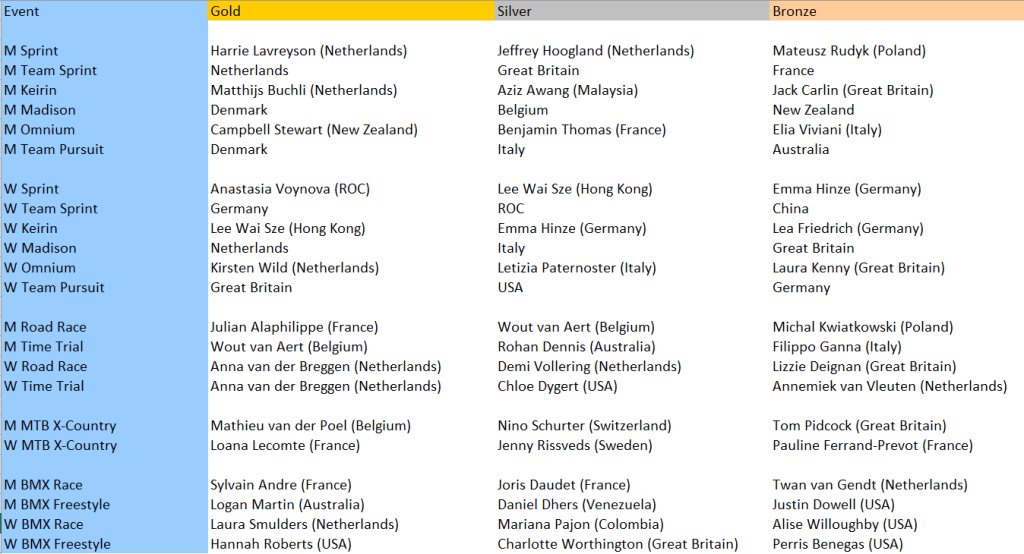
As ever, let me know how wrong I am in the comments below!
 Ian's World Of Sports