Water Sports at the 2020 Olympics

Welcome to Day 2 of the 2020 Olympics! At least, I think it is day 2. My body is physically on US but mentally on Tokyo time, so I’m not quite sure anymore. If I still remember my name by the end of the Games, I’ll be doing well.

Today we’ll be looking at the remaining ‘water sports’ – by which I mean the events happening on the water rather than in it – canoeing, surfing and sailing.

Canoeing

Canoeing at the Olympics comprises two main disciplines – sprint events and slalom event – with each having two categories in it – canoe and kayak. 

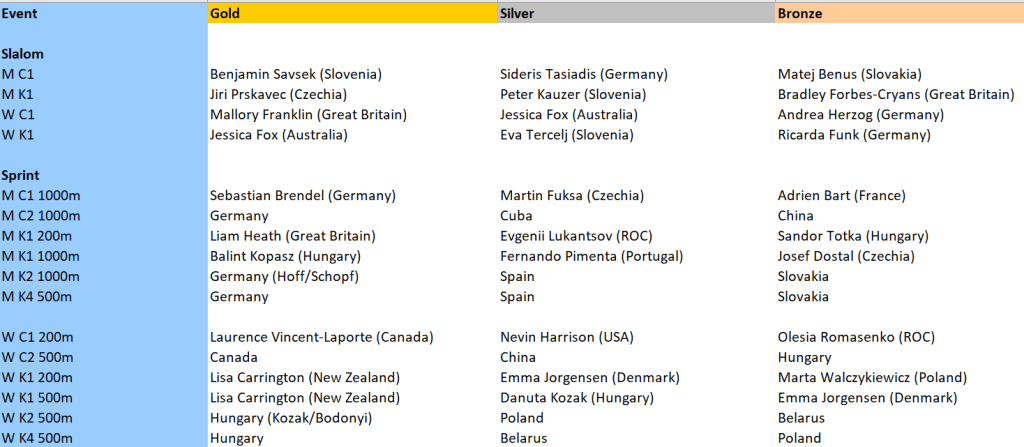
The nation of Slovakia has an outstanding record at the Games and expect them to be strong in both disciplines, especially the Mens C1 slalom. Also look out for Jessica Fox of Australia, who could medal in slalom in both canoe and kayak. Fox – whose parents were both internationals in the sport themselves, albeit for Great Britain and France – has silver and bronze from previous Games and would love to complete the set.

In the sprint events look for the German men to perform well and, on the women’s side, look for Lisa Carrington of New Zealand to potentially top the podium in more than one event.
Surfing

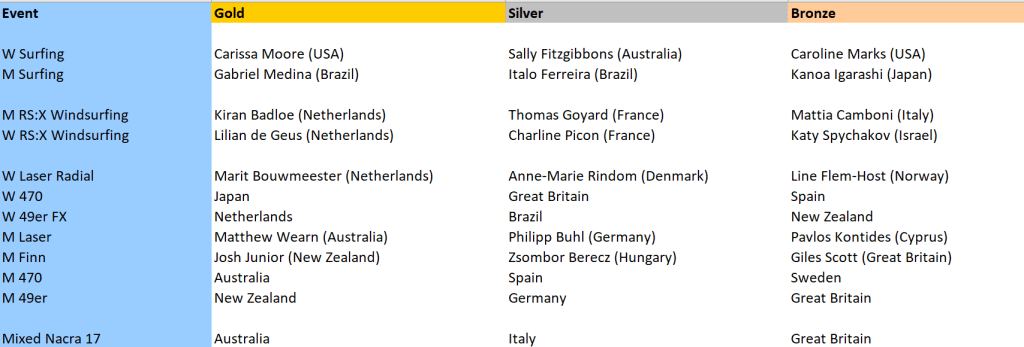
Surfing makes its debut at these Games and has one of the more unusual schedules in the Olympics. Because the event takes place on the ocean and not in a man-made pool, it is hugely reliant on wave conditions and therefore has been granted a flexible schedule of when to happen to allow for the best possible conditions.

Internationally, the event is dominated by two countries – the USA and Brazil, so expect both to be in the battle for medals here.

Sailing

Great Britain, perhaps unsurprisingly for an island nation, tops the all-time medal table in Sailing and will no doubt have realistic medal chances in a number of events, including defending champions from Rio, Giles Scott (in the Finn class) and Hannah Mills (470, although alongside a new partner in these Games). However, the form team for these Games appears to be the Netherlands, who harbour several strong Gold medal chances.

These include being the favourites at both windsurfing events which, confusingly (for me at least), are sailing events rather than surfing events. Anyway, ignore my confusion and focus on the events, which could both be a dust up between near neighbours Netherlands and France.
Swimming at the 2020 Olympics

Swimming has been an ever-present discipline at every modern Games and, along with athletics, is generally considered one of the highlight sports of the games. The swimming at these Games promises to be no exception, with plenty of storied rivalries – both personal and national – on show.

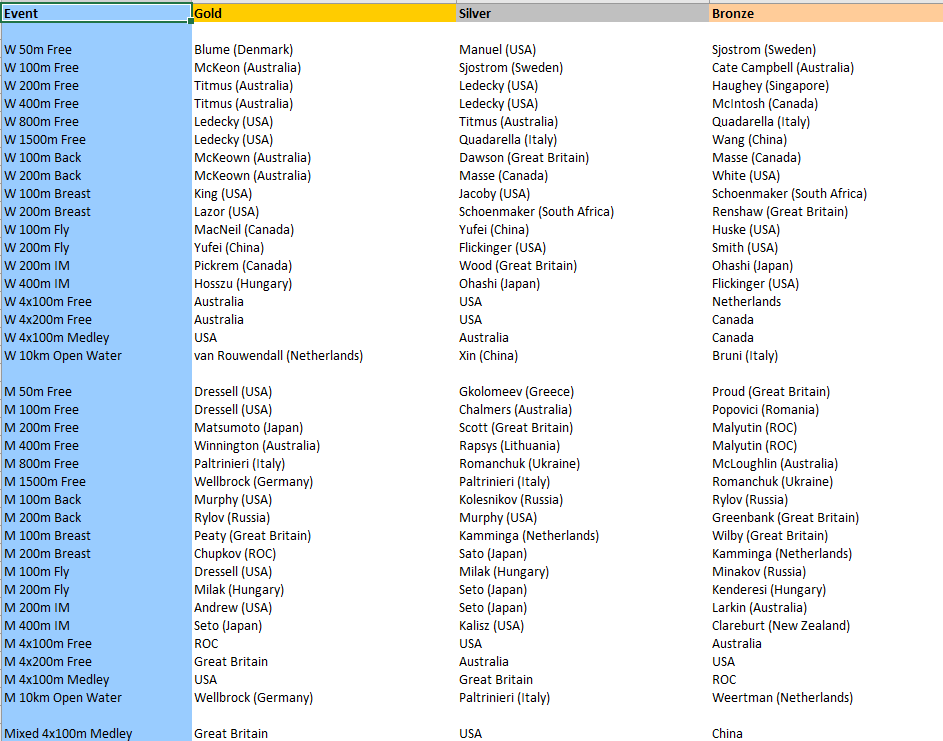
On the Women’s side, the Games seem likely to be dominated by 2 nations – the USA and Australia, who could win 75% of the gold medals between them. Within those national rivalries, there is one personal rivalry that stands out – Ariarne Titmus of Australia – one of the potential breakout stars of the games – up against Katie Ledecky of the USA, who is arguably the greatest female swimmer of all time. The two will clash three times individually – all in freestyle and over three distances – 200m, 400m and 800m. I would expect Titmus to be the favourite over the shortest, Ledecky over the longest and it is anyone’s game for the middle distance! They will also likely meet in the 4x200m freestyle relay, although the Australians are overwhelming favourites in that event.

In other events, we see a renewal of the breaststroke rivalry between Lilly King (USA) and Yulia Efimova (ROC) that developed in Rio. The women’s 100m backstroke promises to be one of the standout events, with the potential for 3, maybe 4, women breaking the current world record if they are on form. Finally we have the ‘veterans’ – Katinka Hosszu (Hungary) and Sarah Sjostrom (Sweden) hoping to retain Golds, although Sjostrom is coming back from serious injury earlier this year.

In the Men’s events, these Games could be known as the Dressel Games. Caeleb Dressel of the USA is favourite in 3 individual events and will obviously be part of very strong US relays. The home nation has strong chances for several gold, with Katsuhiro Matsumoto and Daiya Seto being amongst them. All the male relays promise to be absolute dogfights, with the USA, UK, Australia and ROC all harbouring realistic medal chances in each. Finally, how can we talk about swimming and not mention Adam Peaty, who holds the 15 fastest times in history in the men’s 100m breaststroke. There is no such thing as a ‘sure’ medal in sports but Peaty, barring injury or illness, is likely as close as you can get. 

Martial Arts at the 2020 Olympics

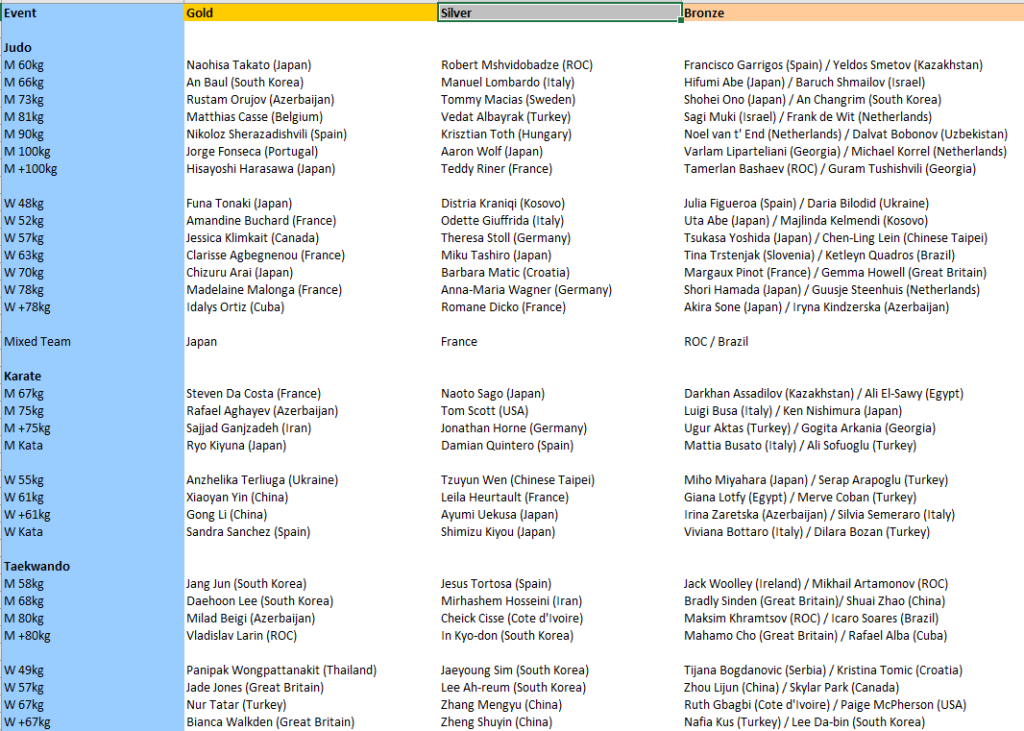
In this post we’ll be looking at the ‘Martial Arts’ at this Summer’s Games. Or, if you prefer, the ‘Fighting Arts’ – Judo, Karate and Taekwondo. Wrestling, which could well be included will have its own post closer to that event’s start later in the Games.

Fairly unsurprisingly, we should expect the home nation (and Asian nations in general) to enjoy a strong Games in these events, especially Karate, which is one of the sports chosen especially by the Tokyo Organising Committee to be showcased this year.

Judo

Judo was first included in the Olympics in 1964 when the Games were held in…Tokyo! With the exception of 1968, it has been a mainstay ever since.

Japan is the most successful nation in the event in terms of medal count and will expect to continue that tradition this year, especially in the new mixed team event, as well as the various individual disciplines.

The next most successful team is France, who will also have several medal chances including two time Olympic – and 10 time World – Champion Teddy Riner, as well as one of their flag bearers, Clarisse Agbegnenou.

Karate

Karate is making its debut this year and will comprise two formats – Kumite and Kata. Put simply (as far as I understand it at least!) Kumite is ‘fighting’ style with competitors actively competing against each other and Kata is ‘form’ style where the winner is determined on artistic grounds, rather than an actual fight. Although someone who understands it better than me can probably tell you how wrong I am here!

Japan are obviously expected to medal well here, although they may face a challenge in the Kata disciplines from the Spanish pair of Sandra Sanchez and Damian Quintero.

Taekwondo

Taekwondo made its full debut in the Sydney Games of 2000 and has been dominated by South Korea and China since then. Expect both nations to go well here, with Jang Jun, Lee Ah-reum and Daehoon Lee all being strong medal favourites for the Koreans.

In terms of other nations, Britain welcomes back their two time Olympic champion Jade Jones to defend her title and will hope that her teammate Bianca Walkden – ranked World number one in her weight class – can join her atop the podium. 

Next up, one of the big draws for any Olympic Games – the swimming!

Racket Sports at the 2020 Olympics

Welcome to the first ‘proper’ day of the Games! I hope you’re all as excited as I am.

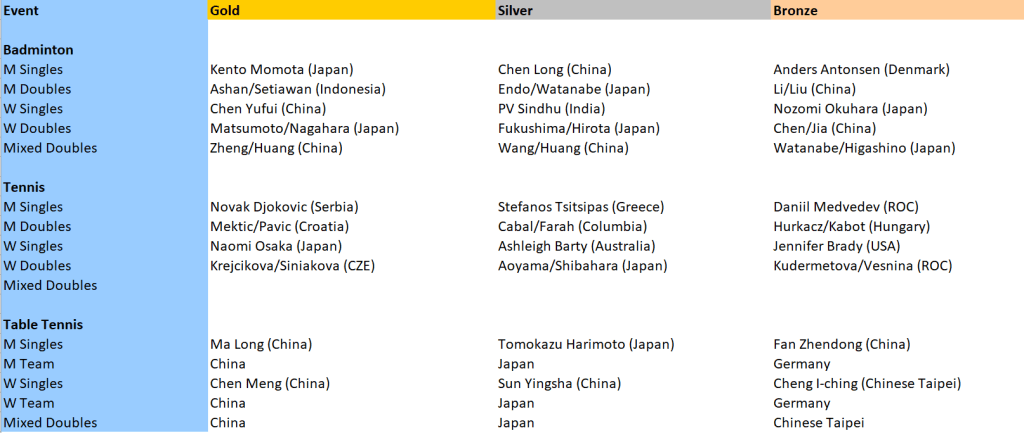
We’re about halfway through the predictions (who knew there were so many events?!?) but we’re close to finishing the events that start over this first weekend. In this post we’ll be looking at the three racket sports in these Games – Badminton, Tennis and Table Tennis.

Badminton

Badminton at the Olympics has been dominated by Asian nations over the years, and this is likely to continue here, at a Games held in Asia. There have been 34 Gold medals awarded in the sport and 32 of them have gone to athletes from Asian countries.

One of the only two non-Asian nations to have won gold is Denmark and they have a chance to repeat that feat again here, with Rio Bronze medalist Viktor Axelsen and current World number 3 Anders Antonsen both harbouring realistic chances of medalling. I also expect the home nation to enjoy a strong Games, with Kento Momota a favourite in the Men’s Singles and with the Women’s Doubles having a realistic potential of a 1-2 finish for Japan.

One word of warning in advance about the Doubles events though – following the 2012 Olympics, changes were made to the format of Badminton (and other sports) which have a group stage to begin with. The draw for the knockout stages will not be made until after the group stage is completed. This is to avoid teams manipulating the draw to avoid a tougher matchup, as famously happened in London, and which resulted in the disqualification of several of the favourites in the Women’s Doubles.

Tennis

Tennis, like Golf, is one of the sports which unfortunately suffers from something of a depleted field at the Games, with many top players choosing to rest following Wimbledon and the French Open, and in advance of the US Open later in the summer.

There are, however, still several superstars of the sport here. None are more famous perhaps than Naomi Osaka, who will represent the host nation and who you might have seen lighting the Olympic Flame at the Opening Ceremony last night! Osaka has a very real shot at Gold, though she will face a tough challenge from newly crowned Wimbledon champion, Ash Barty.

On the Men’s side it is tough to look past Novak Djokovic, especially in the absence of Roger Federer and Rafa Nadal. Djokovic is dominating 2021, have won all three Grand Slams held this year. Two-time Olympic champion Andy Murray returns to defend his crown but is recovering from long term injury and is probably a long shot to defend his crown.

I did consider Murray as a potential doubles medallist with his partner Joe Salisbury, who is an excellent doubles specialist. However, they have been handed an extremely hard draw, facing the French number 2 seeds Mahut and Herbert in the first round. Win that, however, and they could go on a run.

One note – the Mixed Doubles is one of the few events I have not yet predicted. This is because, unhelpfully, the IOC have not announced what teams are competing in it yet! I’ll try and remember to post a prediction when the teams/draw is announced on July 27. 

Table Tennis

If there is a more dominant nation in an Olympic sport than China is in Table Tennis, I don’t know what it is. They have won 28 of the 32 Gold medals awarded in the sport at the Games and I fully expect them to win all 5 here. In all honesty, the most likely unknown is not which country will win, but which athlete from that country will get the Gold! For the record, I think Ma Long and Chen Meng will take their respective individual titles.

One change at these Games is the addition of a fifth event – mixed doubles – to the four events previously contested. In the team events, look for Germany to try and break what could otherwise be an Asian monopoly on the events.

As ever, let me know your thoughts in the comments!

EDIT – as promised, an updated prediction now that the mixed doubles draw has been made. It’s a bit of an oddity, as the teams have been selected based on the combined rankings of the players, but not just their doubles rankings – singles rankings are considered as well. Which means, for example, the number 2 seeds are the Greek pair of Maria Sakkari and Stefanos Tsitsipas whose combined doubles rank would be 376. But because they are respectively numbers 18 and 4 in the world in singles, they have a ranking for the Olympics of 22! This also means that we will see the unusual sight of Novak Djokovic taking part in a mixed doubles tournament. My predictions are as follows:

Gold – Matteck-Sands/Ram (USA)

Silver – Barty/Peers (Australia)

Bronze – Mladenovic/Mahut (France)

Boxing at the 2020 Olympics

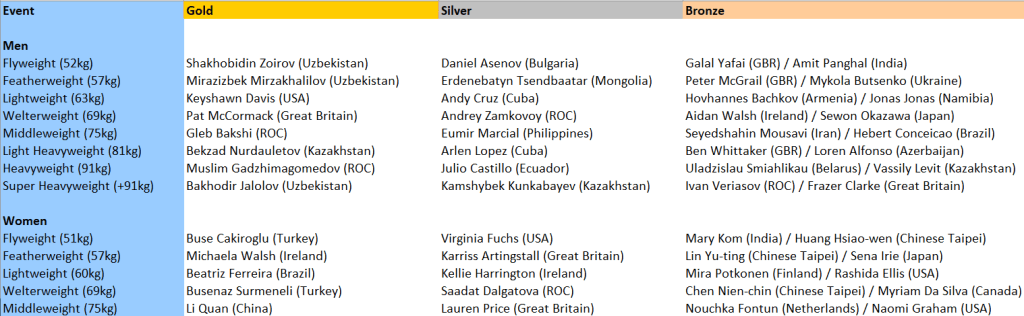
Boxing at the Olympic Games has always retained its amateur status, although many of the athletes who have competed – and medalled – have gone on to become household names in the professional ranks, including Lennox Lewis, George Foreman, Joe Frazier and, of course, the greatest of them all, Muhammad Ali (then still known as Cassius Clay).  Winning an Olympic medal, therefore, is a chance to announce yourself to the world.

However, Boxing is one of the harder events to predict. This is partially because the draws – which were made yesterday – have limited seedings, which can make paths to the semi-final stage (at which point a medal is guaranteed) more random than in some other sports.

Another factor that complicates prediction making (although probably doesn’t bother normal people) is that the Olympic boxing events combines some weight classes, which can make it difficult to determine past form, as some boxers will never have faced each other before now.

Ireland has a proud history in Boxing at the Olympics. In fact, over half of their total Olympic medals have come in this sport. Expect them to have several medal chances, including Michaela Walsh in the Women’s Featherweight. Another nation to look out for is that of Cuba which, like Ireland, has excelled in this event.

Weapon Sports at the 2020 Olympics

It’s Opening Ceremony Day! After the quiet start that inevitably happens with the preliminary matches in some of the team sports preceding the ceremony, the real ‘meat’ of the Games starts tomorrow (or today, depending on where you are in the world). For a nerd like me, this next fortnight will be magical, even in these COVID times.

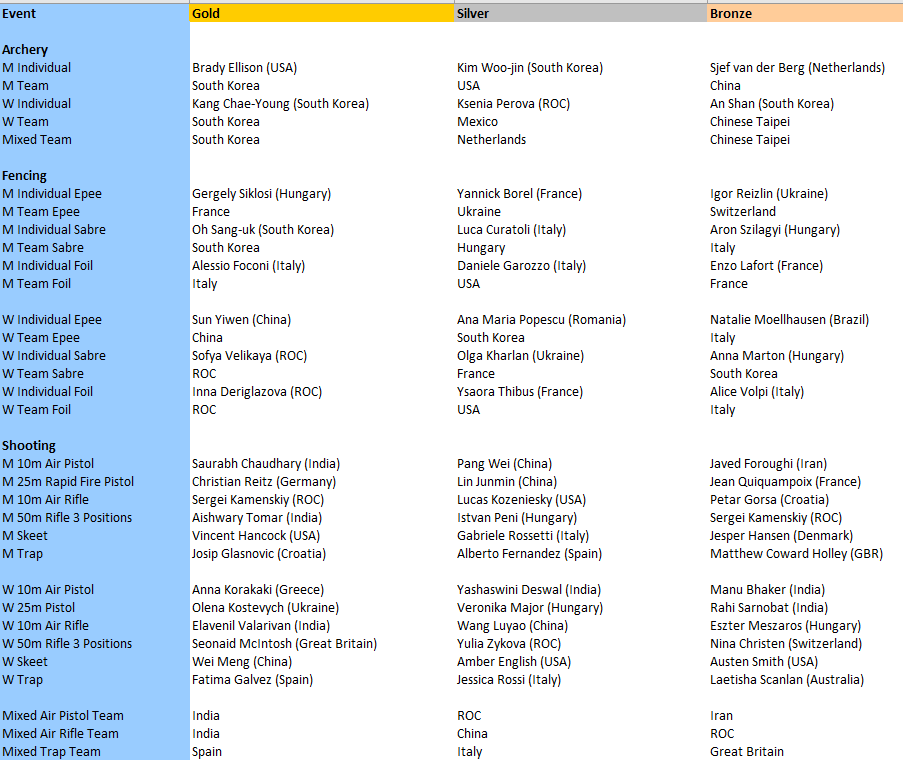
Anyway, back to the predictions. In this post we’ll look at the three sports at these Olympics that I’ve unofficially dubbed the ‘weapon sports’ – Archery, Fencing and Shooting.

Archery

The Archery events at the Olympic Games use the recurve archery format, as opposed to the compound archery type that is also done at the world championships. There are 64 competitors of each gender, who first all compete in a ranking round to determine the seeding, for both the individual events and the team events. For the individual and men’s/women’s team events, all competitors qualify for the next stage. For the new mixed team event, 16 of the 29 teams will qualify, which will be determined by the combined score of the top performing man/woman from each nation.

At the Rio Olympics South Korea dominated the games, winning all four gold medals awarded. Indeed, they are by far and away the most successful nation in modern Olympic archery competitions. In terms of other potential medallists, look to Brady Ellison and the US team to challenge for the men and, on the women’s side, Chinese Taipei (known as Taiwan outside the Games) figure to be among the contenders.

Fencing

The fencing events are tough to predict, as the draw for each event is only being held 24 hours before they start. Not to mention that it isn’t a sport I know that much about!

There are 12 events in total, with individual and team events in each of the three fencing disciplines – epee, foil and sabre. Expect a strong showing from the ROC, South Korea and Italy, all of whom have fine histories in the sport.

Shooting

Like most sports, shooting’s schedule has been streamlined in recent years to try and provide parity in event numbers between Men and Women, as well as to allow for mixed events to take place. In addition, the format is similar to that adopted for the Rio Olympics, where scores are wiped after qualifying and the finalists take part in a series of elimination rounds to determine the medallists.

India, the USA and China are expected to do well in these events. Great Britain has a small team but genuine medal chances in those events, though their prospects have been hit by the last-minute withdrawal of Amber Hill – the world number one in Women’s Skeet – after she tested positive for COVID.

Gymnastics at the 2020 Olympics

I considered just calling this article ‘Simone Biles at the 2020 Olympics’.

Because – especially if you live in the USA – you’re going to be hearing about her a lot over the next week or two.

Put simply, Biles is on another level to most of her competition. She has won 23 gold medals at World Championships and Olympics and has another 7 silver and bronze medals to complement them. She has multiple moves that have been named after her, as she is the only person in the world who has been able to successfully perform them. There are 6 gold medals available in women’s events at these games and she could conceivably win them all. She’s a superstar and will be one of the stars of the Games.

Events on the Men’s side look considerably more open, especially since Kohei Uchimura – who has dominated the Men’s All-Around at the last 2 Games – is limiting his involvement this time out. Look for the pair of Artur Dalaloyan and Nikita Nagornyy, representing the Russian Olympic Committee (ROC), to be challenging for medals, with Britain’s Max Whitlock having a good chance of defending his Pommel Horse title from Rio.

Gymnastics, of course, is not limited to just the Artistic disciplines. The Rhythmic Gymnastics is likely to be dominated by the ROC, with the individual event title potentially a family affair between identical twin sisters Dina and Arina Averina with Dina – the younger sister by 20 minutes – the favourite.

Finally, we have the Trampoline events, with chances for the home nation, especially in the Women’s event.

Rowing at the 2020 Olympics

To quote the esteemed Lt. George in Blackadder Goes Fourth – “Row, row, row your punt, gently down the stream…”

I’d best stop there.

However, the rowing at the Olympics will be considerably less sedate than that suggested in the above ditty. Lt. George himself might not have known this, but the actor playing him, Hugh Laurie, certainly would, having taken part in the famous Oxford and Cambridge Boat Race, in 1980 and – before comedy acting became a career – having considered being a full-time rower himself, with genuine Olympic ambitions.

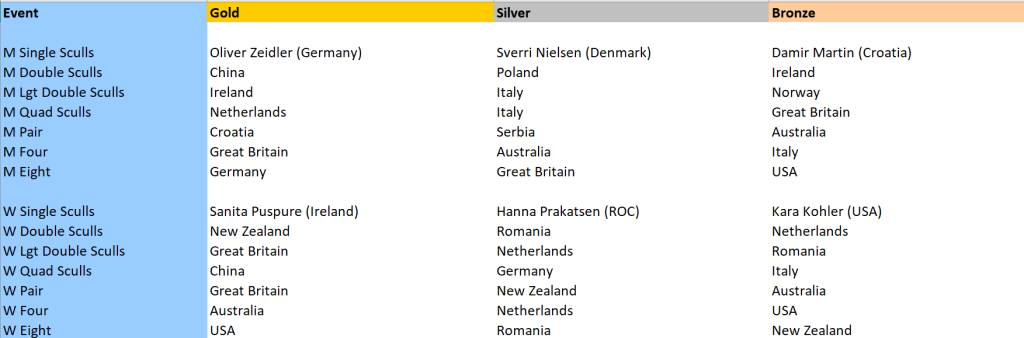
Britain has a proud record in Olympic rowing, behind only the USA in total medals won over the years. Whilst the British squad is perhaps not as strong as it has been in some recent Games, it still harbours several realistic gold medal shots, not least of which is Helen Glover and Polly Swan in the Women’s Pair. Glover, a two-time Olympic champion with former racing partner Heather Stanning, retired after the Rio Games. Now, as a mother of three small children, she has come out of retirement this year to try and make it a three-peat.

Other names to look out for are the Croatia brothers Martin and Valent Sinkovic, who have moved from the Double Sculls – which they won in Rio – into the Men’s Pair where they are double World Champions. Expect the Netherlands and New Zealand to both have strong medal chances in several events. In fact, both New Zealand and Australia may well out-perform my predictions for them – as far as I can tell neither country took part in the usual series of World Cup regattas, so their form is something of an unknown factor.

Finally, Ireland has several good chances to get its first ever Gold at the Olympics. Sanita Puspure is a double world champion in the Women’s Single Sculls and Paul O’Donovan has a shot at going one position better here than the Silver he won in Rio – with his brother Gary in the Lightweight Double Sculls – alongside his new partner Fintan McCarthy.

As ever, let me know how wrong I am in the comments below!

Also, I’m aware that most of the posts right now are predictions based around the Olympics. Obviously, I want to get the predictions out before the events start. But I promise that there will be lots of articles that aren’t predicted based soon, if you aren’t interested in that side of things!

Weightlifting at the 2020 Olympics

The podiums for the Weightlifting events at this summer’s Olympics will have both a familiar and yet different feel to them, if such a thing is possible.

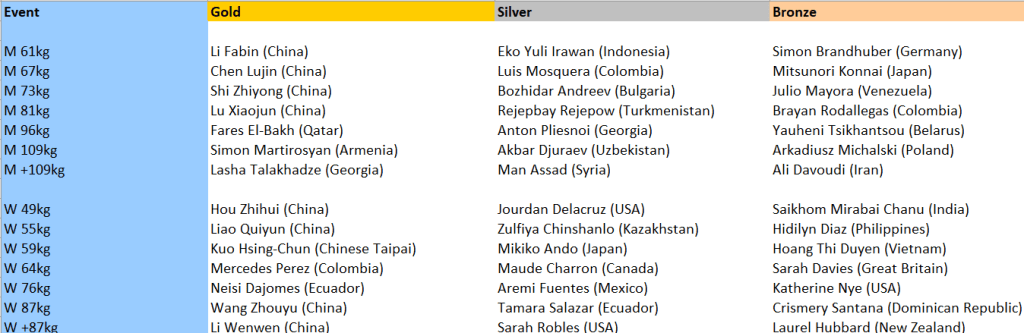
The familiarity will come from China. Chinese lifters won 5 golds at the 2016 games and could easily match – even potentially comfortably exceed – that record this time. Their lifters have dominated the sport in recent years and most go into their event as overwhelming favourite.

The difference will come for two reasons. Firstly, North Korea – a traditionally strong nation in this discipline – has declined to attend these Games at all, citing the current pandemic. Secondly, serious attempts have been made to deal with doping issues in the sport, which seemingly had become endemic. Four countries – Egypt, Malaysia, Romania and Thailand – have been entirely excluded from weightlifting at these Games. Many other countries have had severe limits placed on the number of athletes they can select, based on the severity of the anti-doping violations they have accrued.

All this means that there is potential for some different faces on the podium. Even Great Britain – not a nation noted for a particularly strong medal record in this discipline at the Olympics – has a couple of legitimate outside shots at the podium, with Sarah Davies perhaps the most likely.

Finally, it is fair to say that weightlifting will almost certainly make the wider headlines during the games. Laurel Hubbard of New Zealand will be the first openly transgender athlete to compete at the Games and has a reasonable shot at the podium in the women’s +87kg division.

Cycling at the 2020 Olympics

For the last 3 Games, it would be fair to say that Cycling was a discipline dominated by the British. There were 54 gold medals awarded in Cycling between 2008 and 2016. The British won 22 of them. The next most successful nation over that same period – the Netherlands – won just 4.

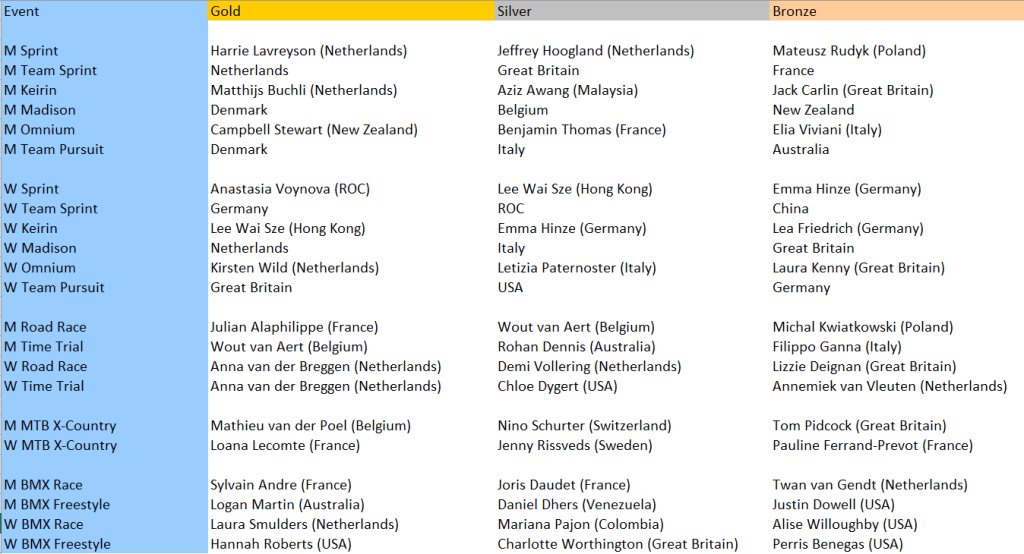
For the 2020 Games, however, British cycling enters the Games as something of an underdog, as results in World Championships and other events have been less than stellar. That being said, I believed the same, to a lesser degree, to be true before the Rio Games and was proven wrong there. The British backroom team – led by the so-called “Secret Squirrel Club” – appear to often underplay the true form of their team at non-Olympic events and then unveil new clothing and bikes at the Olympics to provide their riders with the ‘marginal gains’ that can make the difference between winning a medal or not. It would be foolish to imagine that they could not do the same again, especially on the track, where multiple gold medallists return, led by the formidable couple of Jason and Laura Kenny.

Other teams to look out for include the Danish Men’s team pursuit, who obliterated the world record at last year’s world championships, although they might have their hands full with Filippo Ganna and his Italian quartet. Expect the Dutch, led by Kirsten Wild on the track, to be strong in all cycling disciplines and, finally, we get the return of the glorious insanity that is the Madison after a 12 year absence. More on that in a later post.

Anyone who has ever had the misfortune of listening to me talking about cycling at length will know my view that the Men’s Road Race is one of the most difficult events to predict. So many factors can come into play, from weather, to form (the RR takes place only a week after the end of the 3 week Tour de France) to luck on the day, with the smaller size of national teams – compared to professional races – making it much harder to control. Traditionally therefore, Olympic road races tended to have favoured the so called “Puncheurs” – all around specialists who can compete well over many different types of courses but who lack the true sprint of a Mark Cavendish, or the out and out climbing ability of a Nairo Quintana.

However, the route for this year’s race looks…well, pretty brutal. That should, in theory, favour a climber like Tadej Pogacar, the two time winner of the Tour. If the peleton reaches the foot of the last climb together, a climber will certainly win. But cycling is a funny old sport and my gut tells me that a group will get ahead earlier in the race and stay too far ahead to be caught. If that is the case, look out for the likes of Wout van Aert or Julian Alaphilippe to be in contention.

The time trial courses, as well as the Women’s Road Race course, are still hilly but not quite to the same degree. Even still, the courses probably favour those with good climbing legs, rather than a sprinter or a pure time triallist. The Dutch squad, led by 2016 Gold medallist Anna van der Breggen, could potentially win 5 of the 6 medals available on the road.

For the cross-country Mountain Biking, there is a fascinating clash, with pure MTB specialists, such as reigning champion Nino Schurter and world ranked number 1 Mathias Fluckiger, competing against ‘hybrid’ riders in Mathieu van der Poel and Tom Pidcock, both of whom have won races both on and off-road. On the women’s side, Loana Lecomte enters as a strong favourite.

Finally, we have the BMX events. Whilst BMX racing was added back in 2008, it is joined for the first time at these games by BMX freestyle (aka the one type of cycling I know next to nothing about). But as the event features multi-time World Champions in both Men’s and Women’s events in Logan Martin and Hannah Roberts, it seems sensible to view them as favourites.

As ever, let me know how wrong I am in the comments below!